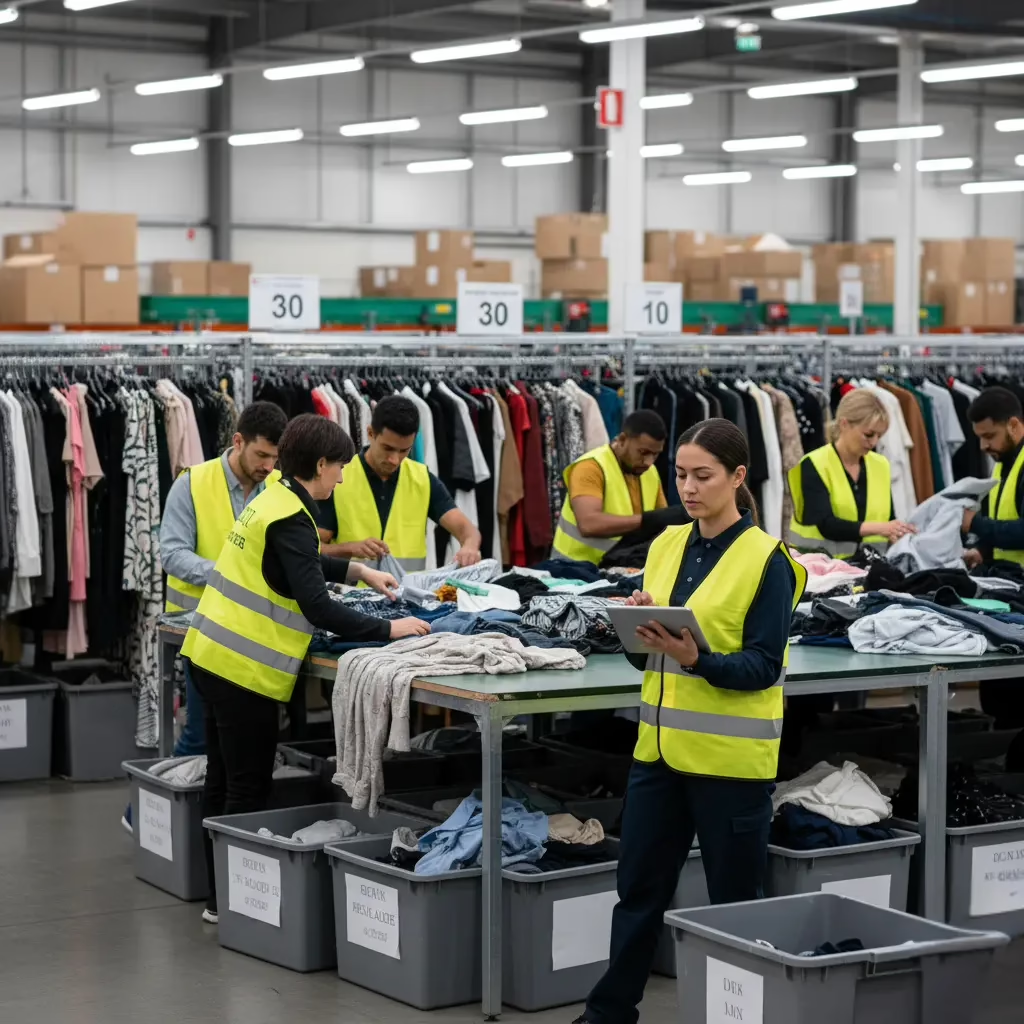
For most fashion brands, returns are not just a customer service issue. They are an operations bottleneck.
When returned units sit in a back room for days (or weeks), you lose twice: once on return shipping and handling, and again when good inventory is unavailable for resale. That delay creates stock distortion, avoidable markdowns, and manual workload your team can’t keep absorbing.
If your business is under $20M and scaling across DTC, wholesale, and marketplaces, the problem compounds quickly. More channels mean more return flows, more status mismatches, and more manual exception handling.
That is where returns management software matters. The right system does not just “process returns.” It shortens your return-to-restock cycle, keeps inventory accurate across channels, and helps your team move faster without adding admin headcount.
In this guide, we’ll break down what to look for, where brands lose time, and how to choose a platform that solves the operations problem—not just the front-end label workflow.
Why return-to-restock time matters more than return volume
Many teams track return rate as the primary KPI. But return rate alone does not tell you how much value you can recover.
A 20% return rate can still be manageable if your team can inspect, disposition, and restock quickly. A 10% return rate can be painful if returns are stuck in a queue for 10+ days.
For fashion brands, slow restocking creates three immediate costs:
Lost sell-through opportunity
Seasonal items and fast-moving sizes have short selling windows. If a returned SKU is unavailable online while it sits unprocessed, you miss full-price demand.
Inventory inaccuracy across channels
If your systems are disconnected, “returned” does not equal “available.” That gap can cause overselling, canceled orders, and poor customer experience.
Manual reconciliation burden
Teams end up fixing data in spreadsheets, ERP screens, warehouse notes, and channel dashboards. The cost is not just labor—it is delayed decisions.
This is why operations leaders should focus on one high-impact metric: average return-to-restock time by SKU condition and channel.
What returns management software should do (beyond labels)
Some tools are excellent for customer-facing return portals but weak in warehouse and inventory execution. Fashion brands need both sides working together.
A practical returns management setup should support five connected workflows:
1) Return initiation and policy control
Customers or support teams should be able to start returns quickly, while your rules engine enforces policy (window, product eligibility, exchange vs refund pathways). This reduces back-and-forth tickets and keeps decisions consistent.
2) Warehouse intake and condition-based disposition
Once units arrive, your team needs a simple intake flow: scan item, verify order, assess condition, and assign disposition (restock, refurbish, outlet, quarantine, or write-off).
The key is speed and standardization. If every return requires custom judgment in Slack or spreadsheets, cycle time will grow with volume.
3) Real-time inventory updates across channels
Returned units that are approved for resale should update available stock quickly in your commerce channels and OMS/WMS stack. Delays here are where margin leaks happen.
Brands running multi-channel operations should prioritize systems with strong integrations and sync reliability. If you are evaluating compatibility, start with your current stack and map it to Blastramp’s integration coverage.
4) Financial and reporting alignment
Returns affect inventory valuation, revenue recognition context, and operational cost tracking. Your software should make it easy to reconcile quantities, statuses, and refund outcomes without month-end fire drills.
5) Performance analytics tied to action
You need visibility into:
- Return-to-restock time
- % restocked vs liquidated
- Top return reasons by SKU/style
- Labor time per 100 returns
- Channel-specific return behavior
Data should drive process improvements, not just reporting.
Common process failures that software should eliminate
If any of these feel familiar, your current setup is likely costing you more than you think.
Disconnected tools by team
Customer support uses one system, warehouse uses another, finance reconciles in spreadsheets, and inventory planning works from stale exports. No single owner sees the full flow.
Return decisions that are not standardized
Teams decide disposition ad hoc, which creates inconsistency. Two identical items may be processed differently depending on who handled intake.
Inventory status lag
Units are physically back but not digitally available, or available in one channel but not another.
Missing root-cause visibility
You know return rates are high, but cannot isolate which styles, vendors, or fit issues drive the biggest margin drag.
Scale pressure on admin headcount
As order volume grows, your team adds coordination work instead of automation. Returns become a growth tax.
For many brands, these problems are tied to broader inventory architecture. If you’re still sorting where returns should live within your stack, this guide on ERP vs inventory management software is a useful starting point.
The business case: how faster restocking protects margin
Let’s keep this simple.
If your brand processes 3,000 returns/month and each return takes 9 days to become sellable, you have a large amount of potentially recoverable inventory sitting idle.
If software and workflow changes reduce that cycle to 3–4 days, you improve:
- Full-price resale probability (especially for in-season inventory)
- Cash conversion speed
- Inventory accuracy for purchasing and replenishment decisions
- Customer promise reliability for popular sizes/colors
You also reduce internal friction: fewer exception tickets, less manual reconciliation, and clearer accountability between operations, warehouse, and finance.
For leaders managing both wholesale and DTC complexity, this ties directly to multi-channel execution maturity. Related reading: wholesale inventory management for balancing B2B and B2C stock.
How to evaluate returns management software for a fashion brand
Use this checklist to run a practical evaluation—not a feature checklist that looks good in a demo but fails in operations.
1) Start with your bottleneck, not a vendor slide deck
Map your current return lifecycle:
- Return initiated
- Label generated
- Unit received
- Quality check complete
- Disposition decision
- Inventory available
- Refund/exchange closed
Then identify where delays happen most often and why.
If you cannot clearly identify bottlenecks, your first requirement is observability.
2) Validate workflow fit for apparel-specific realities
Fashion returns are not generic. Your system should handle:
- Size/color variant granularity
- Condition grading with clear criteria
- Exchange-heavy workflows
- Bundled/kit or multi-item order returns
- Seasonal urgency for high-turn styles
3) Check integration depth, not just logos
“Integrates with X” can mean many things. Ask:
- Is sync near real-time or batch?
- Which statuses sync both ways?
- How are exceptions surfaced?
- What happens if sync fails?
If Shopify is core to your operation, confirm details against Shopify integration capabilities.
4) Evaluate operational UX for non-technical teams
Your warehouse and support teams should not need workarounds to do routine tasks. During trial, test real workflows with actual operators, not just leadership.
Ask your team:
- Can I process a return in under 60 seconds for standard cases?
- Can I find and fix exceptions quickly?
- Is disposition easy to apply consistently?
5) Confirm implementation model and time-to-value
For sub-$20M brands, implementation risk matters. Look for a partner that can map your current stack, define phased rollout, and avoid “rip and replace” disruption.
6) Tie ROI to measurable outcomes
Before go-live, align on baseline and target metrics:
- Return-to-restock time
- Labor hours per 100 returns
- Restock recovery rate
- Oversell/cancellation incidents linked to inventory mismatch
- Time spent on reconciliation
These are executive-level metrics that translate directly to margin and operating efficiency.
What implementation should look like in practice
A strong rollout usually follows this sequence:
Phase 1: Process mapping and data baseline
Document current-state workflows and establish baseline KPIs. This gives you a clear before/after comparison and prevents “it feels better” decision-making.
Phase 2: Integration and rules configuration
Connect your commerce, inventory, fulfillment, and finance-adjacent systems. Configure return reasons, condition logic, and disposition paths so teams follow one playbook.
Phase 3: Pilot on selected channels or SKUs
Start with one return stream (for example, DTC apparel returns) and refine handling rules before scaling.
Phase 4: Full rollout with dashboard ownership
Assign owners for operations metrics and weekly review cadence. Software works best when process accountability is clear.
If you want a broader benchmark for software selection discipline, this 7-point guide is helpful: best inventory management software evaluation for fashion brands.
Where Blastramp fits in your returns operations stack
Blastramp supports fashion brands that are outgrowing manual workflows and disconnected systems.
With Blastramp HQ and Blastramp WMS, teams can align inventory, order, and warehouse operations so returns processing contributes to faster resale readiness—not more admin burden.
Brands typically evaluate Blastramp when they need to:
- Reduce lag between physical return receipt and digital availability
- Improve inventory accuracy across DTC, wholesale, and marketplaces
- Standardize warehouse returns handling
- Scale operations without linear headcount growth
If your operation also struggles with fulfillment delays and warehouse bottlenecks, this article may be relevant: how fashion brands cut fulfillment time by 50% with warehouse inventory software.
For platform details and commercial fit, you can review Blastramp pricing and then move directly to a demo request.
Practical FAQ: returns management software for fashion brands
What is returns management software?
Returns management software is a system that helps brands handle the full return process—from customer initiation to warehouse intake, disposition, inventory update, and refund/exchange tracking. For fashion brands, the biggest value is reducing return-to-restock time while keeping stock data accurate.
How is returns management software different from a return portal?
A return portal is usually customer-facing. Returns management software should also support internal operations: condition checks, disposition rules, inventory sync, and reporting. Portals help collect returns. Operations software helps recover value from them.
What is a good return-to-restock benchmark?
It depends on your category and channel mix, but most growing brands should aim to shorten the cycle enough that in-season items can be resold quickly at full margin. The right benchmark is your current baseline plus a clear improvement target by channel and SKU type.
Can returns software reduce headcount needs?
It can reduce the need to add admin headcount as return volume grows. By standardizing workflows and automating updates, teams spend less time on manual reconciliation and exception handling.
How long does implementation usually take?
Timing depends on stack complexity and process maturity. Brands with clear workflows and clean integration requirements usually move faster. A phased rollout often delivers quicker time-to-value than a full big-bang launch.
Does returns management software help with both DTC and wholesale operations?
Yes—if the platform supports multi-channel inventory visibility and consistent disposition workflows. This is important for brands where DTC and wholesale compete for the same inventory pool.
Ready to reduce return-to-restock time?
If returns are slowing sell-through, distorting inventory, or creating manual workload your team cannot keep scaling, the fastest path forward is a workflow and system redesign built for fashion operations.
Request a Demo to see how Blastramp can help your team shorten return cycles, improve stock accuracy, and scale without adding unnecessary admin overhead.