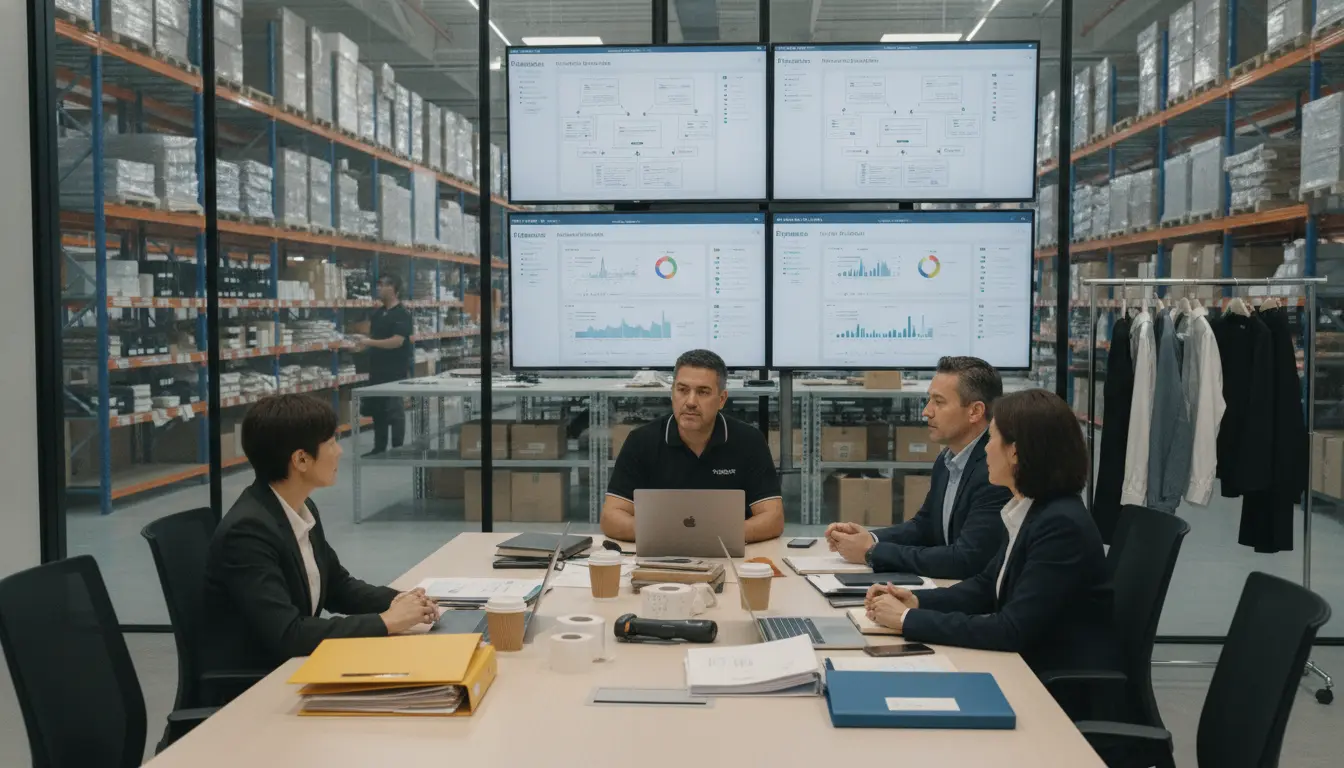
One size medium remains in stock. A DTC customer buys it at 10:02 a.m.; a wholesale rep submits an order against the same unit at 10:04. The inventory update reaches the second channel at 10:07. Both orders were accepted, but only one can ship.
The cost of overselling is more than the margin on one canceled item. It can include customer-service time, split shipping, a discount, contract charges, and the risk that the buyer does not return. Operators need a calculator built from their own numbers, not a generic industry average.
What overselling is—and what it is not
Overselling happens when accepted demand exceeds inventory that can actually be fulfilled. It differs from a planned backorder, where the customer knows shipment will wait; a preorder, where the future availability date is part of the offer; and inventory inaccuracy, which is a cause or separate measurement problem.
Calculate the company’s oversell rate as:
Orders with at least one stock-conflict cancellation or substitution ÷ total accepted orders × 100
Keep customer cancellations separate. The FTC says internet sellers need a reasonable basis for the advertised ship time; if no time is stated, the default is 30 days. If shipment is late, the seller must obtain consent to the delay or refund the unshipped merchandise (Federal Trade Commission). A stock conflict can therefore create a required customer communication and refund workflow, not merely a warehouse exception.
Build a cost-of-overselling calculator from company inputs
Use this monthly formula:
Total overselling cost = lost gross margin + service labor + extra fulfillment + credits + contractual charges + estimated repeat-order impact
Define each input:
- Canceled units × gross margin per unit.
- Service minutes ÷ 60 × loaded hourly labor rate.
- Incremental split or rush shipping caused by the conflict.
- Discounts, gift cards, or credits issued.
- Retailer or marketplace charges only where a contract applies.
- Repeat-order impact using the brand’s own observed rate and value, clearly labeled as an estimate.
Do not add full revenue and gross margin for the same unit. That double counts the loss. If the item is later sold to another buyer at full price, the direct loss may be service and fulfillment cost rather than permanent margin loss.
Worked fictional apparel overselling example
These numbers are illustrative:
| Input | Amount |
|---|---|
| Canceled units | 48 |
| Gross margin per unit | $38 |
| Service time | 18 minutes per case |
| Loaded service labor | $28/hour |
| Extra shipping | $420 |
| Credits issued | $360 |
| Contract charges | $250 |
| Company-estimated repeat-order impact | $600 |
Lost margin is 48 × $38 = $1,824. Service labor is 48 × 18 ÷ 60 × $28 = $403.20. Total estimated cost is $1,824 + $403.20 + $420 + $360 + $250 + $600 = $3,857.20.
Report the $600 separately because it is an estimate. The direct and operational subtotal is $3,257.20. This distinction lets the COO defend the business case without presenting a retention assumption as cash already lost.
Compare the result with the fashion inventory software ROI framework when assessing process changes.
Separate direct, operational, and longer-term costs
Direct costs include lost gross margin, refunds, credits, and applicable contract charges. Operational costs include service time, picking reversals, split shipments, rush freight, and manual reconciliation. Longer-term costs may include reduced repeat purchasing or a weaker retailer relationship, but those require company evidence.
Returns add another state to manage. NRF estimated that 15.8% of annual retail sales would be returned in 2025 (NRF). Use the brand’s own return and restock timing in the calculator; the national figure only shows why return status cannot be ignored.
Map where apparel stock conflicts begin
Five causes recur in fashion operations:
- A channel update arrives after another order is accepted.
- Duplicate or mismatched SKUs split one variant into separate records.
- DTC and wholesale teams allocate from the same pool manually.
- A return appears available before inspection or remains unavailable after restock.
- Inventory is reserved in the wrong state, location, or order.
Trace ten recent cases from accepted order back to the source record. The multichannel inventory management guide explains how shared stock data differs from channel-by-channel files.
Build a one-page case record for each conflict: accepted timestamp, inventory shown, physical count, reservations, channel update time, return state, user action, and final customer outcome. That record distinguishes a three-minute synchronization delay from a duplicate SKU or missed warehouse adjustment.
Segment results by variant and channel. If 14 of 20 cases involve the same black denim size, the problem may be an incorrect mapping or a recurring count error. If cases spread across every low-stock variant during a flash sale, update timing and reservation logic deserve attention.
Use a prevention hierarchy for the final size in stock
Start with clean style-color-size mapping. Then reconcile physical and system inventory, define channel allocations, reserve stock when an order is accepted, alert an owner to exceptions, and document who can release or override a reservation.
No system can promise zero overselling. The aim is fewer conflicts and faster, consistent handling when they occur. Blastramp supports real-time inventory synchronization and multichannel inventory and order management for fashion brands. Its inventory allocation guidance offers a deeper review of channel rules.
Test controls with difficult apparel cases before changing the live process. Place simultaneous DTC and wholesale test orders for the final unit. Receive a return but leave it in inspection. Partially release a wholesale order. Cancel an order after reservation but before pick. The test passes only when every channel, reservation, and available quantity ends in the expected state.
Set an owner for each control. Merchandising owns variant setup, operations owns reservation and exception rules, the warehouse owns physical adjustments, and finance validates cost inputs. Smaller brands may assign several roles to one person, but the responsibilities still need names.
Customer handling needs a script and authority limits. Decide when service may offer a substitute, upgrade shipping, issue a credit, or cancel. Record each cost against the case. That turns an apology workflow into usable operating evidence.
Monthly overselling measurement checklist
- Count affected orders and units by channel.
- Separate brand-caused and customer-caused cancellations.
- Record the SKU, location, and inventory state at acceptance.
- Calculate direct and operational cost from actual records.
- Show estimated repeat-order impact separately.
- Rank root causes by case count and dollar cost.
- Assign one corrective owner and due date.
- Recheck the same cause next month.
The monthly scorecard should show both frequency and cost. Ten conflicts involving low-margin accessories may cost less than two canceled wholesale orders that require rush freight and a contract credit. Rank cases by direct cost, operating minutes, and customer impact rather than case count alone.
Include time from order acceptance to detection. A conflict found before pick may require one service message. The same conflict found after another line ships can create a split order, an extra parcel, and a refund. Reducing detection time may produce savings before the overall oversell rate falls.
Use a fixed reason list so trends remain comparable: channel update delay, count error, duplicate SKU, incorrect reservation, return-state error, manual override, or unknown. Keep “unknown” visible. If it becomes the largest category, the team needs better event history rather than another assumption.
Translate the calculator into an improvement business case
Suppose the fictional $3,857.20 monthly cost repeats for six months. The observed and estimated total would be $23,143.20, while the direct and operational portion would be $19,543.20. Keep those figures separate in the proposal.
Next, estimate the portion a specific change could reasonably address. If 60% of direct costs came from delayed channel updates, do not assign 100% of the total to synchronization. If another 25% came from physical count errors, that needs a warehouse process response.
Add implementation cost, monthly software cost, training time, and any ongoing exception work. Then compare:
Estimated monthly benefit = addressable monthly cost × expected reduction
Payback period = implementation cost ÷ monthly net benefit
Both the addressable share and expected reduction are company assumptions. Show a downside, base, and upside case so the decision does not rest on one optimistic estimate.
Review a stock conflict from order to accounting
Take one canceled navy medium dress and follow every system event. Confirm when the DTC order was accepted, when stock was reserved, when the wholesale order arrived, which quantity each channel displayed, when the warehouse saw the work, and when the refund entered accounting.
This trace often finds cost outside the initial estimate. A service agent may spend 12 minutes finding a substitute, a warehouse picker may handle a canceled line, and finance may reconcile a credit later. Record actual minutes during the review instead of asking teams to remember at month-end.
The exercise also tests ownership. Ecommerce may control the storefront quantity, operations may control reservations, and the warehouse may control adjustments. The final case record needs one owner who confirms the correction across all three.
Cost of overselling FAQ
Should revenue or margin be used?
Use gross margin for the economic loss unless the analysis is specifically about cash collected and refunded. State the method.
Are retailer charges always part of the calculation?
No. Include them only when the agreement applies to the specific failure.
Can an oversold order be saved with a substitution?
Sometimes, but include the service time, discount, and extra shipping required. A substitution is not free merely because revenue remains.
How can Blastramp help?
Blastramp can connect inventory and order workflows and synchronize stock across channels. Sales should review the exact stack, timing, and exception needs.
Find the stock conflict before it reaches the customer
The best calculator uses traceable inputs and keeps observed costs separate from estimates. It shows which failure type deserves attention first.
See Blastramp pricing and request a workflow review to identify where stock conflicts enter the current stack.