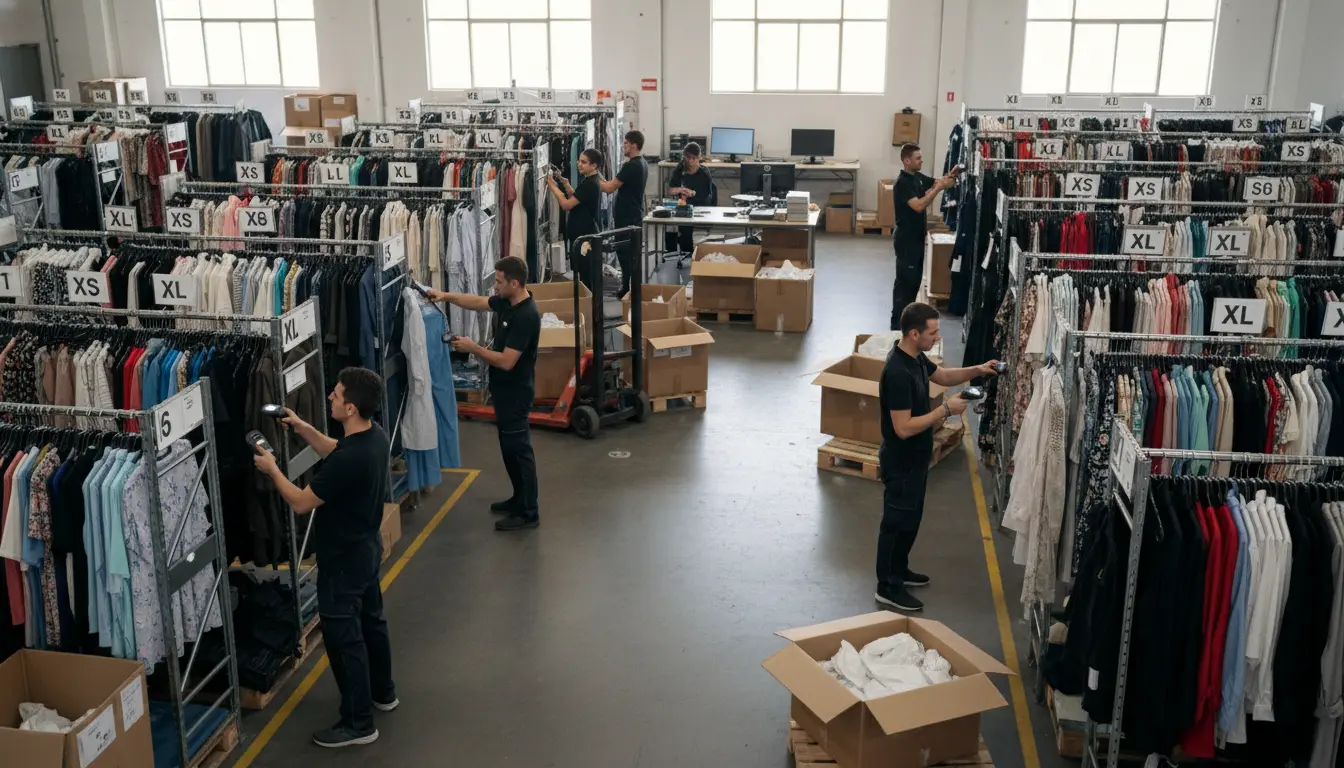
Fashion inventory gets messy fast.
A black ribbed tank may look like one product on a sales dashboard, but the warehouse sees four sizes, two colorways, DTC availability, one wholesale allocation, and returns waiting for inspection. One wrong scan can create an oversell. One late return can make a bestseller look out of stock.
Inventory cycle counting gives fashion brands a better way to keep stock accurate without closing the warehouse for a full physical count. Instead of counting every SKU at once, your team counts smaller groups on a set schedule, checks variances, and fixes the process that caused the mismatch.
For apparel teams, the win is fewer stockouts, faster returns back to available stock, stronger wholesale order confidence, and less time spent arguing with spreadsheets.
What inventory cycle counting means for apparel teams
Inventory cycle counting is the practice of counting selected SKUs, bins, locations, or product groups on a repeating schedule instead of counting the full warehouse in one long shutdown.
A full physical count still has its place, especially before year-end close or during a major system migration. The issue is timing. A growing apparel brand cannot pause Shopify orders, wholesale picks, returns processing, and 3PL handoffs every time stock numbers feel off.
Cycle counting works because it spreads the work across normal operations. The U.S. Government Accountability Office inventory guide recommends partial counts throughout the year, timely research into discrepancies, and procedure updates when count results expose repeat issues (GAO Executive Guide).
A simple example:
- System says: 42 units of the cropped denim jacket, size M, indigo
- Physical count says: 37 units
- Variance: -5 units
- Likely causes: five units were returned but not inspected, picked for a wholesale order but not posted, packed under a substitute SKU, or moved to a photo sample rack without a transfer
A useful count process catches the -5. A better process tells you which issue is actually happening.
If your current system cannot show stock by channel, location, and variant, Blastramp’s guide to choosing inventory management software for fashion brands is a good next read after this article.
Why fashion inventory makes cycle counts harder
Fashion brands do not count “shirts.” They count size, color, channel, and condition.
That is why generic counting advice falls short. An apparel brand counts the same hoodie across six sizes, four colors, a DTC allocation, a wholesale hold, returns in review, and units at a 3PL.
Returns make the problem sharper. NRF reported that retailers expected 16.9% of sales to be returned in 2024, totaling $890 billion, while online returns were expected to reach $362 billion (NRF). Apparel teams feel that pressure every week because size exchanges, bracketing, and condition checks decide whether returned units can be sold again.
Picture a spring dress drop: 600 units arrive across 5 sizes and 3 colors, 140 are allocated to wholesale, 90 sell on Shopify in the first 48 hours, and 22 come back over the next two weeks. If those returned units sit in a “to inspect” pile for five days, the website may show false scarcity while the warehouse is holding sellable stock.
Cycle counts help because they can target the exact pressure points that distort fashion inventory: launch items, exchange-heavy sizes, return bins, wholesale holds, and products moving between warehouse and 3PL locations.
Use ABC counting for sizes, colors, seasons, and returns
ABC cycle counting ranks inventory by business impact so your team counts the most important stock more often.
| Class | What it means | Fashion example | Count frequency |
|---|---|---|---|
| A items | High-value or high-velocity stock | Core denim sizes, best-selling black leggings, new drop units | Daily to weekly |
| B items | Moderate value or movement | Seasonal colors, mid-volume tops, active wholesale replenishment styles | Biweekly to monthly |
| C items | Low-value or slow-moving stock | Archive colors, end-of-season units, low-demand accessories | Monthly to quarterly |
Fashion brands should adapt ABC logic beyond revenue alone. A low-unit item can still deserve A-level attention if it drives customer frustration or wholesale risk.
For example, the last 18 units of a sold-out coat in size S may look small in total value, but if 12 are reserved for a department store reorder, 4 are pending exchanges, and 2 appear available online, the count matters. That SKU needs more attention than a bin of 300 slow-moving scarves.
A fashion-specific ABC model can include size risk, color risk, launch timing, return status, wholesale holds, and location risk across your warehouse, pop-up events, and 3PL partners.
This is where software support becomes more than an upgrade. A system like Blastramp can help keep product, channel, and warehouse data connected so your team is not rebuilding the count list by hand. If disconnected systems are part of the issue, review Blastramp’s integrations to see how inventory data can move across the tools your team already uses.
Set a count cadence that matches SKU movement
The best cycle count schedule is boring. It repeats, fits into the warehouse day, and does not depend on one person remembering which rack looked suspicious last week.
A small fashion brand with 400 active SKUs may start with 30 minutes a day. A larger brand with multiple warehouses may need assigned count windows by location, product group, and sales channel.
| Inventory group | Count cadence | Why it matters |
|---|---|---|
| Bestsellers and core carryover styles | Weekly | High movement creates more scan, pick, and return errors |
| New launch SKUs | Daily for first 1-2 weeks, then weekly | Early sales velocity and exchanges can change availability fast |
| Wholesale-reserved inventory | Before each B2B pick wave | Prevents short shipments and account-service issues |
| Return bins awaiting inspection | Daily or every other day | Keeps sellable units from sitting outside available stock |
| 3PL transfer stock | At ship-out and receipt, then weekly during active selling | Catches transfer gaps before customers see wrong availability |
| Slow-moving archive stock | Monthly or quarterly | Lower risk, but still needs audit control |
Do not build the schedule around the calendar alone. Build it around movement.
A linen shirt that sold 11 units last month does not need the same count frequency as the black bodysuit that sells 40 units every weekend and sees constant size exchanges. The count cadence should follow velocity, margin, return rate, and customer impact.
For teams trying to connect counting with pick, pack, and ship workflows, Blastramp’s article on warehouse inventory management software for fashion brands explains how warehouse process and inventory accuracy affect fulfillment speed.
Build a cycle count checklist your team can follow
A count process should be clear enough for a new warehouse associate to follow without asking the operations lead ten questions.
Use this checklist as a starting point:
- Freeze the count area for a short window. Do not pick, move, or receive units in that bin while the count is active.
- Count by SKU, size, color, and condition. Do not group variants because they look similar.
- Scan where possible. GS1 US notes that barcodes help businesses identify and track products, locations, and inventory movement (GS1 US). For apparel, scanning reduces the risk of mixing small black tanks with medium black tanks.
- Record physical quantity, system quantity, variance, counter name, date, and location.
- Recount variances above your threshold. For A items, that threshold may be one unit.
- Investigate before adjusting. Check open picks, recent returns, transfers, samples, damaged goods, and wholesale holds.
- Adjust with reason codes. Common codes include return lag, missed scan, pick error, receiving error, transfer error, damaged unit, and sample pull.
- Review variance trends weekly. If the same cause appears again, fix the process rather than repeating the same adjustment.
Reason codes turn counts into a map. If return lag appears 18 times in a month, the returns process needs work. If pick error appears in one aisle every week, the bin layout may be confusing.
Track the variance causes apparel brands see most
Most inventory variances are not mysterious. They come from repeated workflow gaps.
Returns are a common one. A customer sends back three sizes of the same dress after choosing one. If the return is not inspected quickly, the sellable units stay hidden. If it is posted before inspection, damaged or worn items may be sold again.
Scan errors are another. Black XS and black XL can look similar in poor lighting. So can navy and black on a busy packing table.
Wholesale holds also create pressure. A sales rep reserves 80 units for a boutique chain, but the warehouse sees the units on shelf and assumes they are free to sell. For brands balancing retail and wholesale, Blastramp’s guide to wholesale inventory management software covers this channel conflict in more detail.
Bundles, samples, photoshoots, pop-ups, PR mailers, and 3PL transfers can also pull units out of available stock without clean adjustments.
Cycle counts reveal these patterns. Weekly variance review turns them into fixes.
How software supports inventory cycle counting without pausing fulfillment
Cycle counts can start in a spreadsheet, but spreadsheets become fragile once the brand sells across Shopify, wholesale orders, marketplaces, and 3PL locations.
The first sign is duplicate work. The warehouse counts in one file, the operations manager checks another export, and customer service still sees a different availability number.
Inventory software helps by giving the team one operating view for:
- SKU, size, color, and location counts
- Barcode-supported count tasks
- Channel allocation and available-to-sell stock
- Return inspection status
- Wholesale reserves
- Transfer and receiving records
- Adjustment history with reason codes
- Reports by variance cause, user, product group, and location
For example, a brand running a 500-unit fall jacket launch can assign daily counts to the top sizes, block wholesale-reserved units from DTC availability, and track returns back into sellable stock only after inspection. The count becomes part of the daily workflow instead of a warehouse interruption.
That matters for teams trying to grow without adding admin headcount. Blastramp HQ starts at USD $750/month and Blastramp WMS starts at USD $1500/month, giving fashion brands options based on order volume, warehouse needs, and channel mix. You can review package fit on the Blastramp pricing page.
If your team is already spending hours every week reconciling counts, returns, and allocations, a demo may be the faster way to see the workflow. Start with a Blastramp request demo and bring two or three real variance examples from your warehouse.
FAQ: inventory cycle counting for fashion brands
What is inventory cycle counting?
Inventory cycle counting is a repeating process where a team counts selected inventory groups throughout the year instead of every unit in one full shutdown. Fashion brands often count by SKU, size, color, location, season, and return status.
How often should fashion brands cycle count inventory?
High-velocity and high-risk items should be counted weekly or even daily during launches. Moderate-volume items may be counted biweekly or monthly. Slow-moving archive stock can often be counted monthly or quarterly.
What is ABC cycle counting?
ABC cycle counting ranks inventory by importance. A items are counted most often because they have the highest sales, margin, customer impact, or operational risk. B items are counted less often, and C items are counted on a slower schedule.
Should returns be part of cycle counts?
Yes. Returns should be counted separately by status: awaiting inspection, sellable, repair, damaged, and rejected. This helps prevent sellable items from sitting outside available stock and prevents damaged items from being sold again.
Can cycle counting replace a full physical inventory count?
Sometimes, but it depends on finance, audit, lender, and control needs. Many fashion brands still run a full annual count while using cycle counts to keep daily stock records cleaner.
What tools help with inventory cycle counting?
Barcode scanning, mobile count tasks, centralized inventory records, return status tracking, channel allocation, and adjustment reason codes all help. The right system should support the way apparel SKUs actually work: size, color, location, channel, and condition.
Keep counting while the business keeps moving
Inventory cycle counting is one of the most practical ways for fashion brands to improve stock accuracy without stopping fulfillment.
Start small. Count the products that create the most customer pain or operational risk. Track every variance reason. Then use those patterns to fix returns, allocations, transfers, and scan errors.
If your team has outgrown manual counts and disconnected stock reports, Blastramp can help connect inventory, orders, returns, warehouse workflows, and channel data in one operating system.
Request a Demo to see how Blastramp can support cycle counts, stock accuracy, and faster inventory decisions.