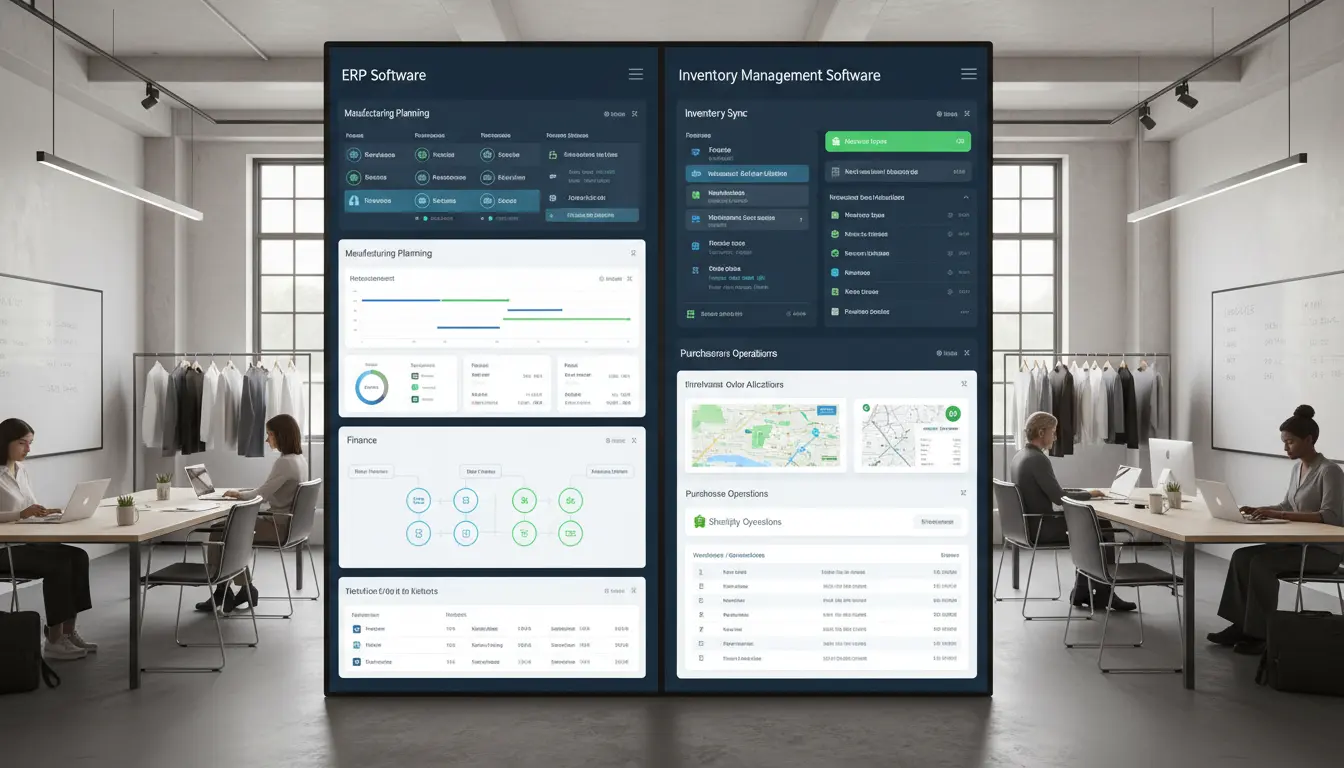
The Real Question Is Not “ERP or No ERP?”
Apparel teams often ask the ERP question too early or too late.
Too early, and they buy a large system before the business has stable processes. The rollout becomes slow, costly, and frustrating. Too late, and production, finance, warehouse, and wholesale teams are all working from different files.
Manufacturing inventory adds pressure because it sits between product development, purchasing, production, finished goods, orders, and finance. A delay at the factory affects available-to-sell dates. A purchase order change affects landed cost. A late invoice affects cash planning. A wrong finished-goods count affects Shopify and wholesale orders.
The best answer depends on what your team needs to control next.
What Manufacturing Inventory Means for Apparel Brands
For apparel, manufacturing inventory can include several layers:
- Fabric, trims, labels, packaging, and components
- Work-in-progress goods at a factory
- Bulk finished goods waiting for inspection
- Finished goods in a warehouse or 3PL
- Units reserved for wholesale, DTC, or retail
- Returns that may become sellable again
Some brands manage raw materials directly. Others only track purchase orders and finished goods from a vendor. A cut-and-sew brand with multiple factories has different needs than a brand buying finished goods from one supplier.
Before choosing software, map what you truly need to track.
| Inventory & Order System May Be Enough
PO status, expected receipts, finished goods, sales allocation |
ERP May Be the Right Next Step
Bill of materials, raw material commitments, production costing, advanced finance, company-wide planning |
When Inventory and Order Management May Be Enough
Many apparel brands under $20M in annual sales do not need to start with ERP. They need reliable control over the work that creates daily errors.
Inventory and order management may be enough when:
- You buy finished goods from factories.
- You need purchase order tracking, not full MRP.
- You need to receive goods into available inventory.
- You need to reserve units for wholesale orders.
- You need Shopify, wholesale, warehouse, and finance data to line up.
- You need better reporting, but not full corporate planning.
- Your accounting system can stay separate and connect through an integration.
| Practical Example
A womenswear brand orders 5,000 units across three styles and five sizes. The team needs to know what was ordered, what arrived, what failed inspection, what is reserved for wholesale, what is available for Shopify, and what invoice data needs to reach accounting. That brand may not need an ERP yet. It needs clean production intake, inventory accuracy, order allocation, and accounting handoffs. |
When ERP Becomes the Better Choice
ERP starts to make sense when the business needs a single system for wider company controls, not just inventory and orders.
Consider ERP when:
- Finance needs deeper reporting across departments.
- Manufacturing requires raw material planning and BOM control.
- Multiple legal entities or regions need shared controls.
- Procurement, accounting, inventory, and production must work from one database.
- Approval workflows are complex.
- Costing needs more detail than basic landed cost.
- The company has dedicated staff to manage implementation and system ownership.
ERP is not only software. It is a business process change. The team must define workflows, clean data, train staff, manage permissions, and maintain the system after go-live.
For a founder-led apparel brand, that can be a lot. If the current pain is mainly overselling, manual wholesale orders, late production receipts, and poor inventory visibility, an ERP may be more system than the team needs right now.
A better path may be to put strong inventory and order controls in place first, then connect to ERP later.
Decision Guide: Four Operating Questions
Use these four questions before choosing ERP or inventory software.
| 1 | What inventory stage causes the most pain?
If the pain is finished goods accuracy, wholesale reservations, Shopify oversells, and 3PL status — focus on inventory and order management first. If the pain is raw materials, factory capacity, BOMs, production costing, and procurement approvals — ERP or a manufacturing system may be a better fit. |
| 2 | Who needs the data?
If operations, wholesale, ecommerce, and the warehouse are the main users — a fashion inventory and order platform may cover the core workflow. If finance, executive planning, procurement, manufacturing, accounting, and operations all need one system of record — ERP is more likely. |
| 3 | How mature are your processes?
ERP does not fix unclear workflows. It makes them visible. If the team has not agreed on PO naming, receiving steps, item status, landed cost rules, and inventory adjustment controls, fix those first. |
| 4 | What can your team support?
A system only works if people maintain it. A smaller team may get more benefit from a focused tool that users adopt quickly than from a large rollout that takes months to stabilize. |
Manufacturing Inventory Workflows to Check in Any System
Whether you choose ERP, inventory software, or a connected stack, test the workflows that matter to apparel.
Purchase orders
Can the team create, track, receive, and close purchase orders? Can partial receipts be handled cleanly? Can expected dates be updated without losing history?
Production status
Can the team see what is ordered, in production, in transit, received, rejected, and ready to sell? This matters when wholesale asks whether units can ship in a specific window.
Lots and batches
Some apparel brands need lot or batch detail for production runs, dye lots, quality issues, or vendor tracking. Ask whether the system can track the level of detail your product team needs.
Finished-goods allocation
Once goods are received, the team must allocate units across wholesale, Shopify, retail, marketplaces, and replenishment. This is where manufacturing inventory meets sales reality.
Returns and production feedback
Returns can signal production issues. If one production run creates a spike in damage or fit issues, the team needs to trace that pattern back to product and vendor context.
A Practical Path for Brands That Are Not ERP-Ready
If ERP feels too heavy, do not stay stuck in spreadsheets. Build the operating base first.
Start with these steps:
- Clean SKU, style, color, and size naming.
- Standardize purchase order status names.
- Define when inventory becomes available to sell.
- Separate on-hand, available, reserved, and incoming stock.
- Connect Shopify, wholesale, fulfillment, and accounting workflows.
- Review inventory accuracy weekly.
- Keep a record of recurring process gaps that may later justify ERP.
This gives the brand a stronger base whether it later chooses ERP or not.
How Blastramp Fits the Decision
Blastramp is not positioned as a full ERP replacement for every business function. It is a fashion-focused inventory and order management platform that helps apparel brands control stock, orders, fulfillment, returns, and connected systems.
For many growing brands, that is the missing layer between spreadsheets and ERP.
Blastramp can help when your team needs to:
- Manage multi-channel inventory by variant
- Track wholesale and DTC orders in one place
- Connect Shopify, QuickBooks, ShipStation, JOOR, NuORDER, Brandboom, Loop Returns, ERPs, 3PLs, and dropshipping services
- Reduce manual order and inventory updates
- Give operations better visibility before seasonal demand spikes
If ERP is still on the table, use a demo to compare workflows. Bring a real purchase order, a production update, a wholesale reservation, a Shopify order, and an invoice handoff. The right answer will become much clearer when the team sees the work end to end.
Frequently Asked Questions
Do apparel brands need ERP for manufacturing inventory?
Not always. If the main need is finished-goods inventory, purchase orders, order allocation, and fulfillment visibility, inventory and order software may be enough. ERP is better for wider finance, procurement, manufacturing, and planning controls.
What is the difference between ERP and inventory management software?
ERP manages broad business functions such as finance, procurement, planning, and operations. Inventory management software focuses on stock, orders, availability, reservations, receiving, and related workflows.
Can Blastramp connect with ERP systems?
Blastramp supports ERP-connected workflows where verified during implementation. Brands should review their specific ERP and data needs with the Blastramp team before making a claim in their process plan.
What manufacturing inventory data should apparel brands track?
Track purchase orders, expected receipt dates, received quantities, rejected units, production status, finished goods, reserved stock, available stock, and invoice handoffs.
When should a brand move from inventory software to ERP?
Consider ERP when finance, procurement, manufacturing, accounting, and operations all need deeper shared controls that go beyond order and inventory workflows.