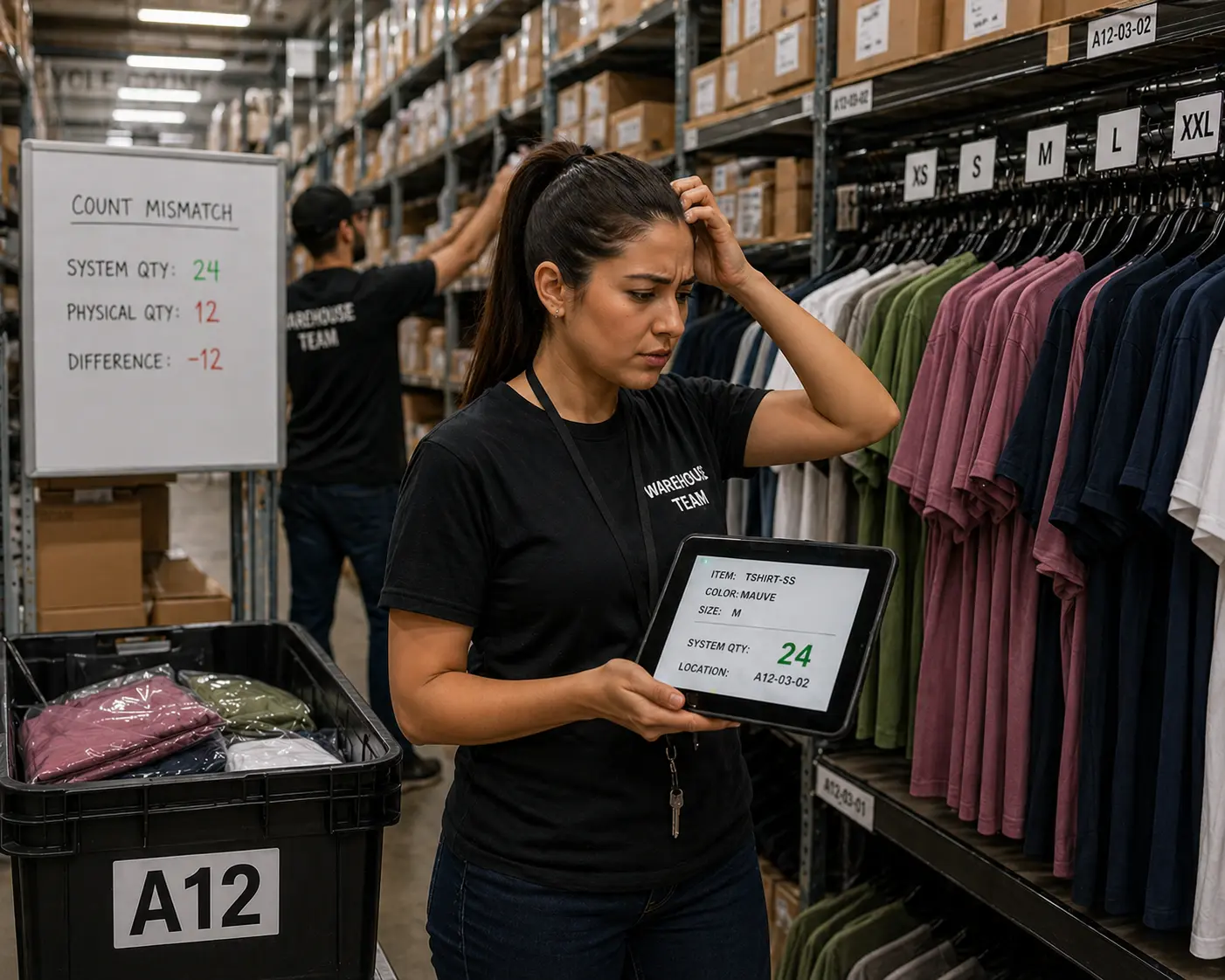
A shopper buys the last black linen blazer in size medium. Shopify says it is available. The warehouse picker cannot find it. The wholesale team has 12 units reserved for a boutique order. Customer service sees one return pending inspection.
That is the kind of mismatch that turns inventory reconciliation into detective work.
For fashion brands, stock errors rarely come from one clean mistake. They come from size and color variants, split DTC and wholesale demand, return delays, 3PL timing gaps, manual edits, bundles, damaged goods, and seasonal pressure. The goal is to find the cause, fix the record, and stop the same issue from coming back next week.
This guide breaks inventory reconciliation into five steps: export, compare, investigate, adjust, and document.
What inventory reconciliation means for fashion teams
Inventory reconciliation is the process of comparing recorded stock against physical stock, then investigating and correcting the gap. A clean reconciliation answers three questions: what does the system say, what is actually available to sell, and why are those numbers different?
That sounds simple until a fashion catalog adds variants. One style can create 40 sellable units before you even count locations: five sizes, four colors, two channels. Multiply that across 300 styles and a small data mismatch turns into a real sales problem.
AccountingTools describes the core task as comparing company records to warehouse stock, finding the reason for differences, and adjusting the records after analysis. For fashion brands, that analysis has to include channel allocations, return status, damaged units, and 3PL movements, not just shelf counts.
A good reconciliation should separate on-hand, available, reserved, in-transit, and quarantined quantities. If those buckets are mixed together, teams keep arguing over the same number. Sales says there are 25 units. The warehouse says there are 18. Both may be right, but they are talking about different inventory states.
Why fashion brands get stock mismatches in the first place
Most reconciliation issues start with timing. The sale happens in one system, the pick happens in another, the return lands at the 3PL later, and the wholesale reserve changes.
Returns are a major source of drift. The National Retail Federation reported that retailers expected 16.9% of annual sales to be returned in 2024, totaling $890 billion. Apparel brands feel that pressure quickly because fit, size, color, and customer expectation drive repeat return behavior.
Common mismatch patterns include:
- Variant confusion: size small in black gets received against size small in charcoal.
- Return limbo: a customer return is refunded but not inspected or moved back to sellable stock.
- Wholesale holds: units are reserved for a boutique order but still appear available to DTC shoppers.
- 3PL delay: a transfer arrives at the warehouse, but the receipt update posts the next day.
- Marketplace timing: a sale from one channel syncs after another channel has already sold the same unit.
- Damaged stock: units are counted on hand even though they should be removed from sellable stock.
- Manual adjustment: someone fixes a count without adding a reason, so the team cannot trace the cause.
A growing brand may tolerate this with 50 SKUs. At 500 SKUs, it starts causing oversells, refunds, lost wholesale trust, and slow month-end close.
Blastramp’s wholesale inventory management guide explains how B2B and DTC stock compete when allocation rules are not clear.
Step 1: Export the right inventory data before touching the count
The first mistake is reconciling from one report. A Shopify export alone will not show warehouse quarantine status. A 3PL report may not show wholesale reserves. An accounting file may lag behind operational reality.
Start with a fixed reconciliation window. For example: Monday at 8:00 a.m., after weekend orders are batched but before new receiving begins. Freeze the cut-off time, then pull the same fields from each system every time.
Your export should include SKU and variant ID, style name, color, size, location, on-hand quantity, available quantity, reserved quantity, open order quantity, return pending quantity, damaged quantity, inbound transfer quantity, last adjustment date, and last fulfillment timestamp.
For a DTC and wholesale brand, the most useful comparison is often SKU by location by status. A total count for one blue dress is too broad. You need to know whether size 8 is physically in the Vancouver warehouse, reserved for a Joor order, pending return inspection, or available for Shopify.
Brands using connected systems should check whether their stack is sending the right source data. Blastramp’s integrations page is relevant here because reconciliation works best when ecommerce, shipping, accounting, and wholesale systems pass order and stock updates into one operational record.
Step 2: Compare records in a variance table
Once the exports are ready, build a variance table. This does not need to be fancy. It needs to be consistent.
Create one row per SKU, variant, location, and status. Then compare system quantity against counted or confirmed quantity. The difference is your variance.
A simple table might include:
| SKU | Location | System on hand | Physical count | Reserved | Available | Variance | Owner |
|---|---|---|---|---|---|---|---|
| BLAZER-BLK-M | Main 3PL | 24 | 21 | 12 | 9 | -3 | Ops |
| DRESS-IVY-8 | Store | 6 | 7 | 0 | 7 | +1 | Retail |
| TEE-WHT-S | Returns bin | 14 | 9 | 0 | 0 | -5 | CX |
Do not group every variance into one bucket. A negative variance in a picking bin means something different from a negative variance in a returns bin. A positive variance can be just as suspicious as a shortage if stock was received into the wrong variant.
Set thresholds so the team knows what to review first. For example:
- Any variance on a top 20 SKU gets reviewed the same day.
- Any DTC sellable variance below zero blocks further sales until checked.
- Any wholesale reserve variance gets reviewed before order confirmation.
- Any return-bin variance older than 48 hours gets assigned to customer service or warehouse ops.
Step 3: Investigate the cause, not just the number
The fastest way to create repeat problems is to adjust the count without finding the cause. If size medium keeps disappearing from the system, a manual correction only hides the issue until the next drop.
Work through the variance by event history. Look at the last receipt, transfer, sale, pick, return, exchange, wholesale reserve, and manual edit for that SKU. Then tie the variance to a likely cause.
Common fashion scenarios look like this:
- Variant swap: two similar colors were received under the wrong barcode.
- Return status gap: five returned tees were refunded, but only two passed quality check.
- Wholesale reserve issue: a sales rep increased a boutique order from 20 to 30 units after DTC stock had already been published.
- 3PL receipt delay: a transfer was physically received Friday, then posted Monday after weekend ecommerce orders had pulled from expected stock.
- Bundle error: a set sold as one product did not decrement each component size.
Use evidence before blame. Pull pick tickets, return logs, receiving photos, adjustment notes, and channel timestamps. If your team uses barcode scanning or RFID, include scan history. GS1 notes that RFID programs can lift item-level inventory accuracy to over 95%.
For brands comparing warehouse and inventory platforms, Blastramp’s article on warehouse inventory management software covers how warehouse workflows affect accuracy.
Step 4: Adjust inventory with reason codes and approvals
After the cause is known, make the inventory adjustment. This is where many teams lose audit quality. A note that says “fixed count” is not enough.
Use clear reason codes, such as:
- Receiving error
- Pick error
- Return inspection update
- Damaged stock
- Lost stock
- Wholesale reserve correction
- Transfer timing
- Variant correction
- Bundle component correction
- Manual data error
Each adjustment should include the SKU, location, old quantity, new quantity, reason code, owner, date, and evidence link. For larger adjustments, require approval from operations or finance before the change posts.
A one-unit variance on a $22 tee may only need warehouse sign-off. A 30-unit variance on a $280 coat should trigger a finance review, especially if it affects wholesale promises or shrink reporting. Fix the record, but leave a trail.
Step 5: Document the pattern and prevent the repeat
The final step is the one teams skip when the warehouse is busy. They fix the count, ship the orders, and move on. Then the same problem appears again the next month.
Document patterns in a weekly reconciliation log. Keep it short enough that people will use it.
Track top variance SKUs, units adjusted by reason code, affected channels, owner, fix status, and follow-up. If 60% of adjustments come from returns, fix the inspection and restock workflow. If wholesale reserve errors keep causing oversells, tighten allocation rules. If the 3PL posts receipts late every Friday, agree on a cut-off process before the weekend sale window.
This is also where inventory reconciliation becomes a planning tool. IHL and Sensormatic have reported that inventory distortion cost retailers an estimated $1.77 trillion in 2023. That number is global, but the lesson is local: small stock errors add up through markdowns, missed sales, oversells, rush shipments, and staff time.
If your team wants to see how a connected inventory setup works across channels, Blastramp’s how it works page explains the operating model, and the Shopify integration page shows how ecommerce stock updates fit into the wider workflow.
How often should fashion brands reconcile inventory?
The right cadence depends on SKU velocity and channel risk. Monthly reconciliation is often too slow for high-volume DTC items, especially during launches, holiday periods, or wholesale market season.
Use this as a starting point:
| Inventory segment | Suggested cadence | Why it matters |
|---|---|---|
| Top-selling DTC variants | Daily or 2-3 times per week | Prevents oversells on fast movers |
| Wholesale reserved stock | Before order confirmation and before ship date | Protects buyer commitments |
| Returns bins | Daily during peak return periods | Gets sellable units back online faster |
| 3PL transfers | At every receipt cut-off | Catches timing gaps before sale windows |
| Slow-moving stock | Monthly or cycle count schedule | Keeps records clean without overloading staff |
| High-value products | Weekly or per movement | Reduces shrink and finance surprises |
Reconciliation should be more frequent when the cost of being wrong is high. A one-day mismatch on a slow-moving accessory may not matter much. A one-day mismatch on a sold-out dress with wholesale demand can lead to cancellations, support tickets, and buyer frustration.
Brands planning a system upgrade can review Blastramp’s pricing page to compare inventory and warehouse options by operational need.
Software tools that reduce reconciliation work
Software does not remove the need for inventory reconciliation. It reduces the manual chase and makes causes easier to find.
Look for support for variant-level stock by size, color, and location; separate statuses for available, reserved, return, and damaged units; channel allocation rules; order and transfer history; barcode scanning; reason codes; approvals; audit logs; and reporting by variance cause.
The biggest gain is shared truth. Operations, customer service, wholesale, and finance should not need four reports to answer whether a unit can be sold. They need one trusted record with enough detail to explain the number.
FAQ
What is inventory reconciliation?
Inventory reconciliation is the process of comparing inventory records against physical or confirmed stock, investigating any differences, and correcting the records with a clear reason. For fashion brands, it should include variants, locations, reserves, returns, damaged units, and 3PL timing.
What causes inventory discrepancies in fashion retail?
Common causes include variant receiving errors, late 3PL updates, unprocessed returns, damaged goods, marketplace sync delays, wholesale reserves, manual edits, and bundle component mistakes.
How do you reconcile inventory across DTC and wholesale?
Separate on-hand stock from available and reserved stock. Then compare DTC availability, wholesale allocations, open orders, returns, and physical counts by SKU, variant, and location.
How often should inventory reconciliation be done?
Fast-moving DTC variants and returns bins may need daily checks. Wholesale reserves should be reviewed before order confirmation and shipping. Slower stock can be reconciled monthly or through a cycle count schedule.
What is the difference between cycle counting and inventory reconciliation?
Cycle counting is the act of counting a defined set of stock on a set cadence. Inventory reconciliation compares those counts against system records, investigates differences, updates the records, and documents the cause.
Build a cleaner reconciliation process with Blastramp
If your team is reconciling inventory from spreadsheets, 3PL exports, Shopify reports, and wholesale order notes, the process will always take more time than it should. Blastramp helps fashion brands manage inventory, orders, warehouse workflows, and channel connections in one operating system.
Use it to track variants, reserves, returns, and stock movement with clearer ownership and fewer manual corrections. To see whether Blastramp fits your current stack, request a demo and walk through your reconciliation workflow with the team.