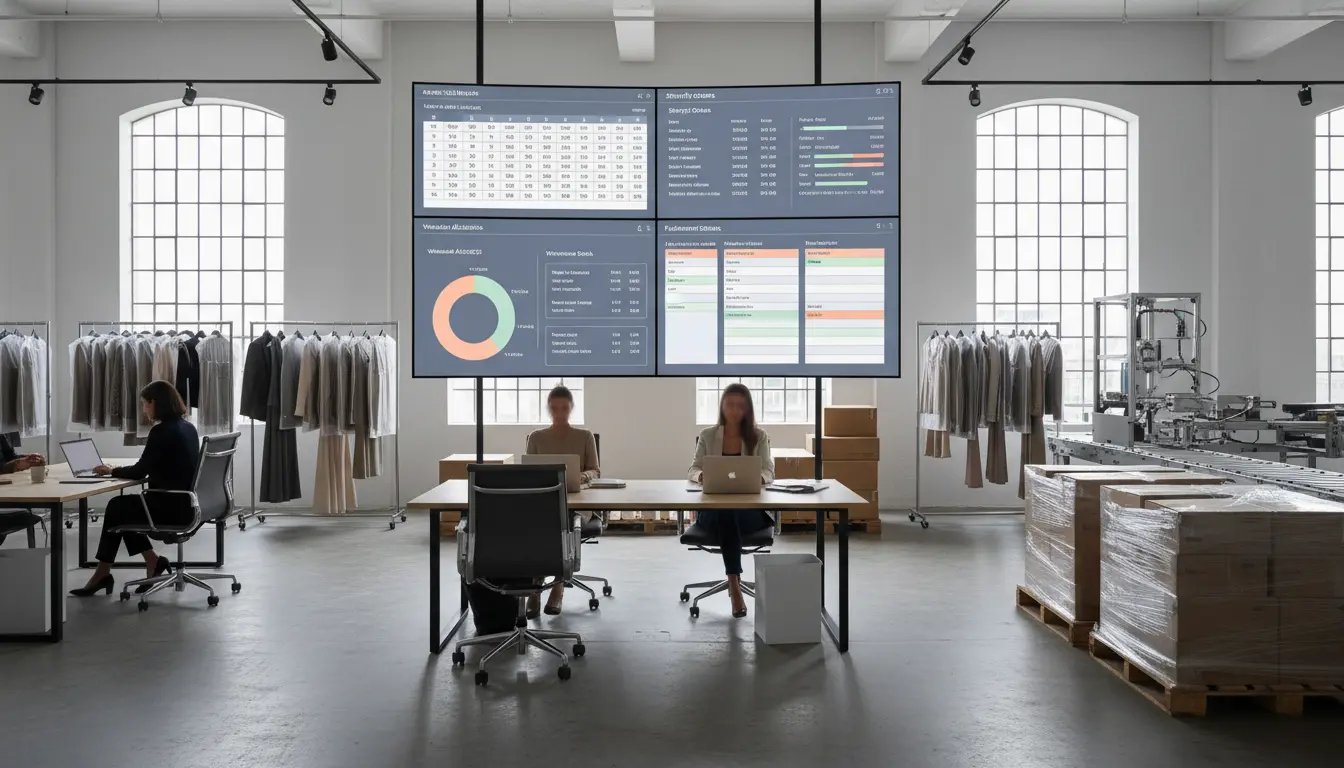
Why Spreadsheets Break Before the Brand Feels “Big”
A small apparel business can look simple from the outside: a few collections, a Shopify store, several wholesale accounts, maybe one 3PL. Inside the operation, the math is not simple at all.
One style may have six sizes, four colors, two channels, and several order statuses. A 40-style seasonal drop can create hundreds of SKU records before preorders, returns, wholesale holds, and warehouse transfers enter the picture. That is where a spreadsheet stops acting like a planning tool and starts acting like a risk.
The warning signs usually show up in small ways:
- A wholesale sales rep promises stock that Shopify already sold.
- A buyer asks for an updated ATS report and the team needs half a day to build it.
- Operations holds back too much inventory for wholesale and DTC sells out too soon.
- A return comes back in sellable condition, but no one adds it back fast enough.
- The founder is still checking order status in three systems at 10 p.m.
For apparel brands under $20M in annual sales, the real question is not “Are we large enough for software?” It is “Are we losing too much time and stock control by waiting?”
What Wholesale Distribution Software Should Do for a Small Apparel Brand
Good wholesale distribution software should give the team one operating view of orders, inventory, customers, and fulfillment. It should not force a small team into heavy ERP processes before they are ready.
For fashion, the system needs to understand how apparel is sold:
- Inventory by size, color, style, and season
- B2B orders with payment terms and ship windows
- DTC orders from Shopify
- Wholesale reservations before final pick and pack
- Stock moving through a warehouse, 3PL, or dropship partner
- Returns that need to be inspected and added back to sellable inventory
The software should also reduce manual handoffs. If the wholesale team takes an order in one place, operations should not have to copy that order into another file, check Shopify manually, email the warehouse, and then update QuickBooks by hand.
| Blastramp HQ
Multi-channel inventory & order management Starting at USD $750/month |
Blastramp WMS
Warehouse management & fulfillment operations Starting at USD $1,500/month |
The Size-Color Matrix Test
Before choosing any wholesale distributor software, run a simple test: can it handle the real shape of your apparel catalog?
A generic wholesale tool may be fine for cases of one product, one unit, one quantity. Apparel is different. A bra line may need band size, cup size, color, pack rules, replenishment notes, and account-level buying patterns. A denim brand may need inseam, waist, wash, and seasonal drops. A children’s brand may need age ranges and gift-season spikes.
Ask these questions during evaluation:
Can the system show availability by variant?
A buyer does not just ask, “Do you have the ribbed tank?” They ask for XS through XL in black, oat, and navy, with delivery before a store reset. Your team needs to know what is available now, what is reserved, and what is expected from production.
Can it separate available stock from reserved stock?
Wholesale orders often sit in the system before they ship. If those units still appear as available to Shopify, overselling follows. If the team over-reserves for wholesale, DTC can lose sales.
Can it support partial shipments?
Small apparel brands often ship what is ready and backorder the rest. The software needs to track what shipped, what remains open, and what finance or customer service needs to know.
This is where spreadsheets get hard to trust. They can hold data, but they do not protect the team from two people editing the same truth at the same time.
What to Check Before You Outgrow Basic Tools
Multi-channel order capture
Wholesale, Shopify, marketplace, and manual orders should land in one place. If the team still checks orders in separate dashboards every morning, the system is not solving the core problem.
Blastramp connects with platforms such as Shopify, QuickBooks, ShipStation, JOOR, NuORDER, Brandboom, Loop Returns, ERPs, 3PLs, and dropshipping services. The goal is to reduce manual copying and make order status easier to see.
Inventory control across B2B and DTC
Wholesale and DTC teams often compete for the same units. Good software lets the business set rules for reservations, allocations, and backorders instead of debating stock in a chat thread.
Fulfillment status
A growing brand needs to know whether an order is open, picked, packed, shipped, partially shipped, or waiting on stock. If a buyer asks for status, the answer should not depend on who last emailed the warehouse.
What to Avoid in a Small-Business Software Decision
- Avoid tools that only manage products, not orders. Apparel brands need both. Inventory without order context can still lead to poor allocation.
- Avoid tools that make every update manual. If the team has to export Shopify orders, upload wholesale orders, and rebuild reports each week, the spreadsheet problem has only moved into a new interface.
- Avoid tools that cannot grow into warehouse or 3PL workflows. Many small brands start with an outside fulfillment partner. Later, they may add more warehouse control. Software should not force a full rebuild every time the operation changes.
Ask to see the exact workflow for a seasonal drop, a wholesale reorder, a partial shipment, and a return-to-stock process. If the demo stays generic, keep asking.
When to Move From Spreadsheets to Software
Do not wait until the spreadsheet fails during peak season. The best time to move is when the team can still plan the change calmly.
A small apparel brand is usually ready when two or more of these are true:
- You sell through both Shopify and wholesale.
- You have more than 200 active SKUs or variants.
- Wholesale reps need live stock answers.
- Returns are not added back quickly.
- The founder or COO is still manually checking stock.
- The warehouse or 3PL needs cleaner order data.
- Production planning depends on old inventory counts.
- You are hiring admin support mainly to copy data between tools.
The cost is not only software spend. It is also lost time, preventable errors, and buyer trust.
A Practical Rollout Plan for a Small Apparel Team
A good rollout does not need to be dramatic. It should be controlled.
- Map your current order paths — List every place an order can enter the business: Shopify, wholesale portal, email, EDI partner, marketplace, sales rep, showroom, and 3PL portal. Then mark where inventory is updated.
- Clean core SKU data — Before migration, align style numbers, colors, sizes, barcodes, and product naming. Poor SKU data will cause problems in any system.
- Pick one workflow to test first — Start with a common flow, such as a wholesale reorder or Shopify order sync. Prove that inventory, order status, and fulfillment updates work before adding every edge case.
- Set weekly controls — Review open orders, stock discrepancies, returns waiting for inspection, late shipments, and backorders each week until the team trusts the new process.
Where Blastramp Fits
Blastramp is a good fit for fashion brands that have outgrown spreadsheets but are not ready for a costly enterprise build. The platform brings inventory and order data into one working system, with fashion-specific workflows that account for channel mix, size-color matrices, wholesale orders, returns, and fulfillment.
If that sounds familiar, request a Blastramp demo and walk through your current wholesale, Shopify, and fulfillment workflow with the team.
Frequently Asked Questions
What is wholesale distribution software for a small business?
It is software that helps a small company manage wholesale orders, inventory, customers, and fulfillment in one system. For apparel brands, it should track stock by size, color, style, and sales channel.
Is a spreadsheet enough for wholesale distribution?
A spreadsheet can work at the start. It becomes risky when multiple channels sell the same stock, wholesale orders need reservations, and fulfillment updates need to move quickly.
What is the difference between wholesale distribution software and inventory software?
Inventory software tracks stock. Wholesale distribution software should also manage customers, orders, reservations, ship status, and reporting for B2B sales.
Do small apparel brands need an ERP?
Not always. Many brands need inventory and order control before they need a full ERP. If finance, manufacturing, payroll, and corporate planning need one connected system, ERP may be worth reviewing.
How much does Blastramp cost?
Blastramp HQ starts at USD $750 per month. Blastramp WMS starts at USD $1,500 per month. See Blastramp pricing for current package details.